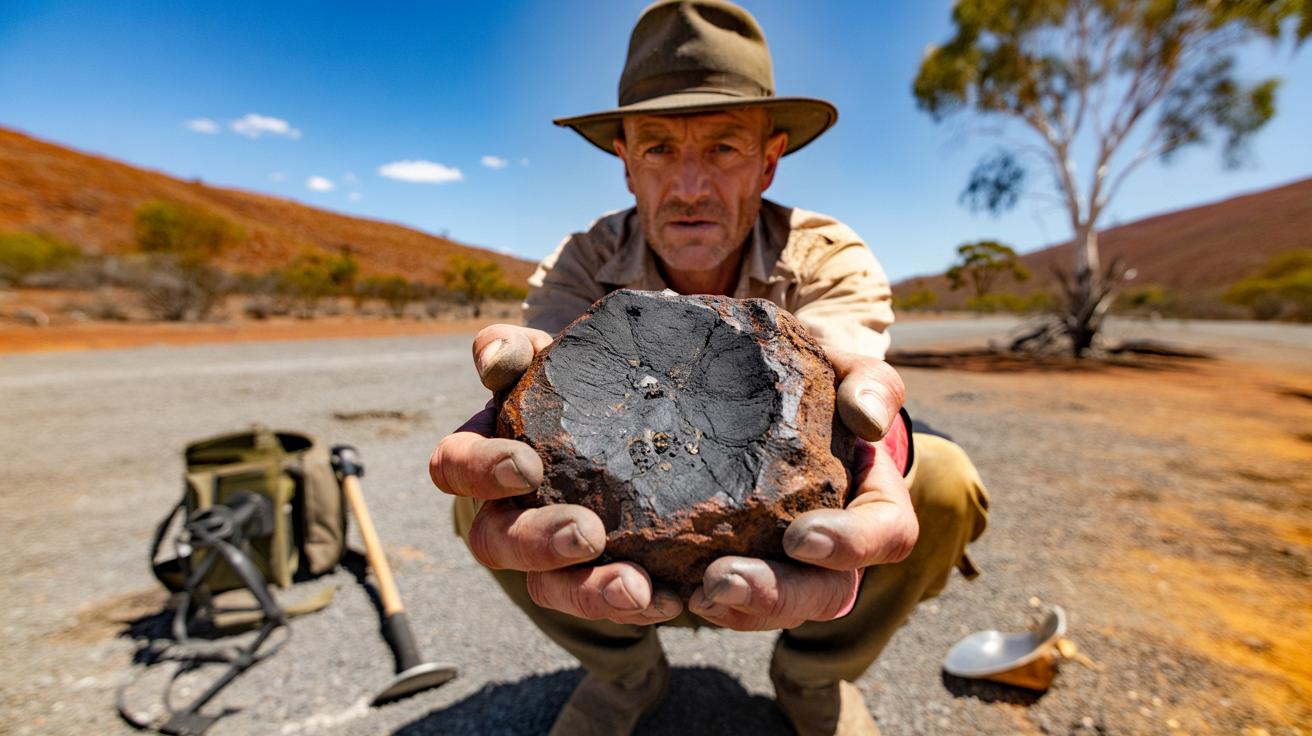
The sun was already high over the ochre hills of Victoria when the man stopped walking. His metal detector had let out that slightly different beep, the one prospectors learn to hear not with their ears, but with their whole body. He knelt down, brushed away the dry Australian soil, and saw it: a strange, dark, heavy lump, half-buried like a forgotten secret. His heart raced. Gold, surely. Out here, that’s the dream everyone quietly carries.
He grabbed the stone and felt its weight. Too dense. Too smooth in some places, oddly pitted in others. He slipped it into his backpack anyway, already adding up imaginary numbers.
What he didn’t know, as he climbed back toward his dusty car, was that he wasn’t holding a gold nugget at all.
He was holding a rare piece of the solar system.
From gold fever to cosmic shock in rural Australia
On the outskirts of Maryborough, a small town in the Australian state of Victoria, locals are used to the quiet obsession of gold hunting. The region is layered with old rush stories, half-true legends and whispered directions passed from one prospector to another. So when an Australian man picked up a 17-kilo rock in a dry creek bed, thinking he’d finally hit the jackpot, his reaction was almost automatic: protect it, weigh it, dream about it.
The rock didn’t shine. It didn’t sparkle in the sun. Still, it felt promising. Dense. Solid. Oddly magnetic in its own way. At home, he tried to crack it with a saw. Nothing. It barely scratched. Gold-rich quartz usually gives in more easily. This thing resisted like it had another story.
Perplexed, the man eventually took the mysterious lump to the Melbourne Museum, where geologist Dermot Henry has seen his share of “gold that isn’t gold”. According to Henry, he’s been handed thousands of “meteorites” and “treasures” over his career. “Hundreds of them,” he said, “and only two turned out to be real meteorites.” That day, though, the expert needed just one look.
The strange stone was a genuine meteorite. Not just any rock from the sky, but a very rare type with a high iron content. It had travelled through space for billions of years, survived the fiery violence of Earth’s atmosphere, and then patiently waited in Victorian soil until someone with a metal detector happened to walk by. The odds of that meeting are almost absurd.
Scientists believe this meteorite could be 4.6 billion years old, formed at the birth of our solar system. Think about that for a second. While our species has existed for only a tiny dot on the cosmic timeline, this space rock was already there, drifting between planets, colliding, cooling, being bombarded by radiation. By mistaking it for gold, the prospector had unknowingly put his hands on a fragment older than Earth’s oldest rocks. The monetary value is still debated, but the scientific value? That’s on a completely different scale.
How to tell a meteorite from “just another weird rock”
Most of us wouldn’t recognize a meteorite even if we stubbed a toe on one. We walk past potential space relics on beaches, in fields, on hiking trails, quietly convinced they’re nothing special. The Australian finder almost did the same. What changed everything was that stubborn mix of curiosity and doubt: “What if this isn’t gold… but still something rare?”
➡️ Dit eten voor het slapen zorgt voor een perfecte nachtrust
➡️ De nanny van de Prins en Prinses van Wales ontvangt een zeldzame koninklijke onderscheiding
The first simple gesture, if you find a suspiciously heavy rock, is this: weigh it in your hand. Meteorites, especially iron-rich ones, feel oddly dense compared to regular stones of the same size. Then, look for a dark, burned-looking surface and tiny thumbprint-like dents called regmaglypts. They form as the rock melts slightly while shooting through the atmosphere.
Another easy test is the magnet. Most meteorites, particularly those rich in iron, react strongly to a magnet, sometimes almost jumping toward it. That doesn’t mean every magnetic rock is from space, of course, but it’s a first filter. People often stop at this stage, convinced they’ve found an alien object, then get crushed when a museum tells them it’s just industrial slag or an old piece of smelted metal.
We’ve all been there, that moment when hope outruns facts for just a second. Turning that hopeful rock over in your hand, you’re already writing the story in your head: the viral article, the interviews, the money. Then reality knocks. This is exactly why scientists repeat the same advice: document, test, then get it checked. Slowly.
Professional geologists insist on one thing: don’t cut your “maybe-meteorite” before expert analysis. The Australian prospector tried to saw his open, and he was lucky he didn’t damage it too badly. A genuine meteorite carries inside it tiny structures and minerals that tell the story of its journey. Once you cut it randomly, that story can be much harder to read.
“Every meteorite is like a time capsule,” explains geologist Dermot Henry. “When people drill, polish or break them before bringing them to us, they erase clues we can never get back.”
To avoid that, specialists often recommend a basic checklist:
- Check the weight in your hand: is it surprisingly heavy for its size?
- Look for a dark, fused outer crust with tiny “thumbprints”.
- Test with a magnet, but don’t scratch or drill the surface.
- Photograph the rock where you found it, with surroundings.
- Contact a local museum or university geology department before doing anything else.
*Let’s be honest: nobody really does this every single day.*
Why this story sticks with us long after the headlines
The more you think about that Australian prospector, crouched over his “gold” in the dust, the more it feels like a small parable about us. We chase one kind of treasure and stumble on another. He went looking for money and found a piece of time itself. A 17-kilo reminder that the universe doesn’t care about our expectations, but sometimes drops a gift at our feet anyway.
This kind of story lingers because it touches something simple: our instinct to search, and our talent for being wrong in interesting ways. How many things in our daily lives do we misjudge at first glance, dismiss as ordinary when they’re quietly extraordinary? A rock, a person, a place we pass every day.
Next time you’re out walking, maybe you’ll look twice at that strange dark stone by your shoe. Maybe you’ll picture a man in Australia, thinking he’d found gold, and you’ll wonder what silent relics are hiding in your own landscape, in plain sight, waiting for someone curious enough to stop and pick them up.
| Key point | Detail | Value for the reader |
|---|---|---|
| Rare meteorite discovery | An Australian prospector mistook a 17 kg space rock for gold near Maryborough | Shows how extraordinary finds can hide in familiar places |
| How to recognize one | Unusual weight, dark fusion crust, magnet reaction, thumbprint-like dents | Gives practical clues if you ever find a suspicious rock |
| Scientific meaning | Meteorites can be 4.6 billion years old and hold clues to the solar system’s birth | Links a personal story to the larger story of our cosmic origins |
FAQ:
- How did experts confirm the Australian rock was a meteorite?Geologists examined its density, surface texture and internal structure, then used lab tests to confirm its extraterrestrial origin and iron-rich composition.
- Are meteorites worth more than gold?Some rare types can sell for very high prices, but value depends on size, rarity, condition and scientific interest, not just weight.
- Can anyone legally keep a meteorite they find in Australia?Rules vary by state and land ownership; on private land it may belong to the landowner, and on protected areas it may fall under heritage or museum laws.
- How common are meteorites on Earth?Earth is constantly hit by space debris, yet identifiable meteorites are still rare at the surface because many burn up, erode, or get lost in oceans and vegetation.
- What should I do first if I think I’ve found a meteorite?Photograph it in place, gently collect it without washing or cutting, note GPS coordinates, then contact a museum or university geology department for assessment.