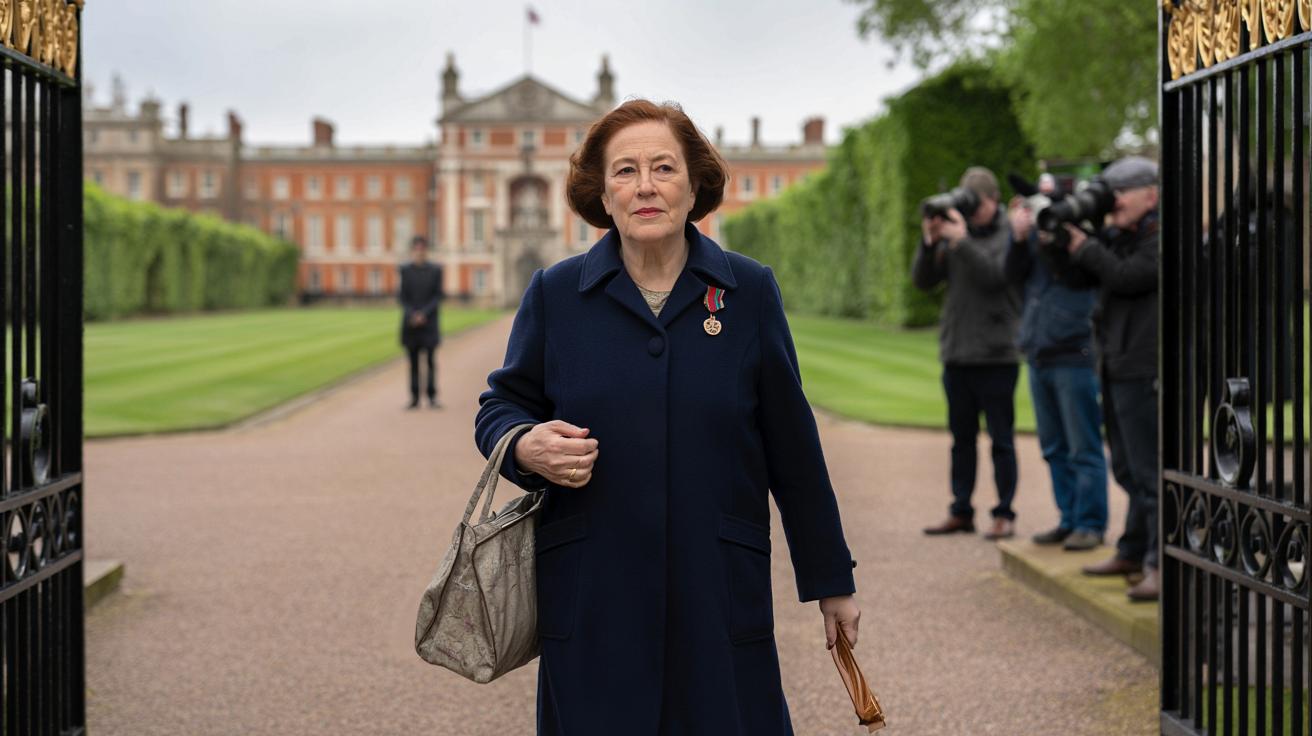
On a grey London morning, a small woman in a navy coat slipped quietly through the palace gates. No balcony appearance, no gleaming tiara, just a discreet smile and a well-worn handbag. Yet the photographers waiting outside Kensington Palace knew exactly who she was. This was the nanny who had rocked royal babies to sleep, soothed their tears after long tours, and stood just off-camera while the world watched them wave.
Inside, the walls held more than portraits and protocol. They held the echoes of bedtime stories, tiny footsteps on parquet floors and whispered Danish lullabies. Today, those invisible years of service were about to be pulled into the spotlight.
For once, the Crown had turned to face the woman behind the royal nursery door.
Who is the royal nanny being honoured?
The nanny at the heart of this story is Maria Teresa Turrion Borrallo, the Spanish-born professional who has cared for the three children of the Prince and Princess of Wales since 2014. She trained at the prestigious Norland College, the almost-mythical institution known for its brown uniforms, white gloves and almost military discipline in childcare.
When Prince George was just eight months old, Maria quietly entered the royal household. No fanfare. Just a new pair of sensible shoes in the palace corridor and a calm, firm presence in the nursery. Since then, she’s become a constant shadow in family photos, at Trooping the Colour, royal weddings and those chaotic airport tarmacs during foreign tours.
If you look back at the images from the Canada tour in 2016, you’ll spot her. While the world focused on George in his tiny blue sweater and Charlotte clinging to her mother’s hair, Maria stood a few steps behind, in her tailored Norland uniform, scanning the scene. One hand gently guiding, one eye always tracking.
She’s there too at Princess Charlotte’s christening, holding the baby’s cardigan. At Meghan and Harry’s wedding, guiding a restless George and a shy Charlotte up the chapel steps. Her presence is always practical, never decorative, a moving reminder that even royal children need someone to zip their coats and wipe their noses. The cameras rarely zoom in. Parents do.
The distinction now bestowed on her – a rare royal honour for a nanny in the modern era – says out loud what the palace usually leaves unsaid. That behind the polished image of a “modern royal family” stands a professional who has quietly held the line of normal life.
The British honours system usually shines on generals, civil servants and celebrities. For a nanny to be singled out sends a subtle but powerful message: emotional labour counts, unseen care counts, the person who keeps the show on the road counts. It doesn’t erase the power imbalance between crown and employee. Yet it cracks open the door to acknowledging the work that never makes the commemorative plates.
A rare royal honour for a life of invisible work
The award Maria received is a royal honour that very few household staff ever touch. Historically, some royal nannies received recognition, but those days feel more like dusty footnotes from the Victorian era. In a 21st-century monarchy under constant scrutiny for its relevance, choosing to honour a nanny is a striking gesture.
➡️ Dit eten voor het slapen zorgt voor een perfecte nachtrust
Behind the formal wording – “for services to the Royal Family” – lies something messier and more human. Nights spent pacing with fevers. Jet-lagged toddlers melting down before a balcony appearance. School runs under umbrellas while the press waits at the gates. The honour wraps all that chaotic, unphotogenic care in a small, elegant ribbon.
We’ve all been there, that moment when you watch someone hold your child and realise they know their rhythms almost as well as you do. For William and Kate, that person has been Maria for a decade. Imagine entrusting not just your child, but the public image of your family, to someone who is always half a step behind you on global stages.
When Kate underwent abdominal surgery and stepped away from public duties, insiders quietly noted how the children’s routine was kept as normal as possible. School, sport, play, bedtime. The palace never spelled it out, yet anyone who has juggled illness and family knew exactly who would be anchoring those days. The nanny whose name most headlines still mispronounce had, once again, become the quiet stabiliser of a royal storm.
The logic behind this honour is both traditional and surprisingly modern. Traditional, because royal households have always relied on trusted staff who dedicate their lives to service. Modern, because the conversation around care work, women’s labour and “who actually holds things together” is finally starting to shift.
Let’s be honest: nobody really thinks about who packed the crayons and spare socks when they watch a royal walkabout. Yet when the Crown shines a light on the nanny, it tacitly acknowledges that those small domestic choices shape the big public moments. You can’t have a smiling, waving, well-adjusted future king on a balcony without someone having spent years at eye-level with him on the nursery floor.
What this says about royal parenting today
One striking detail about Maria’s role is how visible, yet carefully framed, it has become. Kate and William are often seen doing the school run themselves, chatting with other parents, carrying backpacks. Then, a few days later, a long lens catches Maria waiting at the same gates, holding the same bags, wearing practical flat shoes.
There’s an intentional choreography there. The message: this is a hands-on royal couple, but they also work, they travel, they represent the Crown. So they share the load with a highly trained professional who knows the children’s worlds just as well as they do. *It’s not the fantasy of a mother who does everything; it’s the reality of a family that outsources what it can so it can survive what it must.*
Many parents watching this dynamic from their phones recognise a softer version of their own juggling act. Maybe you don’t have a Norland nanny, but you rely on a neighbour, a grandparent, a childminder, a crèche. You might feel guilty on the days when your child reaches for that other adult first. Or when the caregiver knows their teacher’s name before you do.
Honouring Maria sends a quiet reassurance through that guilt. That relying on someone else does not make you less of a parent. That sharing the weight of raising children is not a failure, but a structure. The common mistake is pretending you can do it all, act cheerful and perfect, and never need backup. The Waleses, with all their privilege, are still indirectly saying: we don’t. We can’t. So we don’t pretend.
“Maria has been a constant in the children’s lives from the very start,” noted one royal watcher. “In a world where everything shifts – schools, homes, staff, public pressure – she is the familiar face who never changes, and the children know it.”
- Her trainingNorland College drilled her in everything from first aid to cyber safety, self-defence to early years psychology. That mix of care and quiet security work is exactly what a 21st-century royal nanny needs.
- Her discretionNo interviews, no “tell-all” books, no calculated leaks. For a family burned before by betrayal, that loyalty is worth almost as much as the childcare.
- The timing of the honourComing after intense scrutiny on the Wales family, this recognition reads like a public thank-you to the person holding the private threads together when the cameras move on.
The nanny, the crown and the rest of us
When a royal nanny receives a rare honour, it doesn’t just shift something inside the palace. It quietly nudges the way we all talk about care, loyalty and the value of “ordinary” work. Behind every polished public figure, there is almost always a Maria: the person who deals with the tears before the speech, the homework after the interview, the breakfast dishes before the awards ceremony.
You might think of your own version reading this. The neighbour who always steps in at the last minute. The nursery worker who knows your child’s favourite story better than you do. The grandparent who buys the same cereal every time you visit because change is hard for small people. The royal honour hanging on Maria’s wall won’t fix the pay and status gap in care work. Yet it cracks the narrative just enough to let a new truth in: the ones we trust with our children carry a kind of quiet power.
The palace will carry on, with its processions and portraits and polished statements. George, Charlotte and Louis will grow, and one day Maria will slip back through a gate for the last time, as discreetly as she arrived. But this small medal on her chest leaves a trace in public memory. It reminds us that behind the balcony and the headlines, a woman once knelt on a playroom rug, built a Lego castle, and helped a future king learn how to be simply, and safely, a child.
| Key point | Detail | Value for the reader |
|---|---|---|
| Maria’s rare honour | The royal nanny of the Prince and Princess of Wales receives formal recognition for her service | Shows how invisible care work is starting to be acknowledged publicly |
| Modern royal parenting | William and Kate share childcare with a trusted professional, while staying visibly involved | Normalises asking for help and sharing the load at home |
| Changing view of caregivers | Highly trained nannies like Maria blend emotional care, security and education | Invites readers to see their own caregivers as skilled, not “just help” |
FAQ:
- Question 1Who is the nanny of the Prince and Princess of Wales who received the honour?Her name is Maria Teresa Turrion Borrallo, a Spanish-born Norland-trained nanny who has cared for Prince George, Princess Charlotte and Prince Louis since 2014.
- Question 2What kind of royal honour did she receive?She received a rare royal distinction reserved for close, long-term service to the royal household, formally recognising her role in supporting the Wales family.
- Question 3Why is this honour considered rare for a nanny?Very few domestic staff, and even fewer nannies in the modern era, are singled out in the official honours system, which usually focuses on public, military or political service.
- Question 4What makes Norland nannies like Maria different from other nannies?Norland nannies undergo rigorous training that covers childcare, security awareness, first aid, behaviour management and professional discretion, making them particularly suited to high-profile families.
- Question 5What does this story change for ordinary parents and caregivers?It doesn’t change daily life, yet it adds symbolic weight to the idea that caregivers deserve respect, recognition and, ideally, better status for the complex work they do every day.