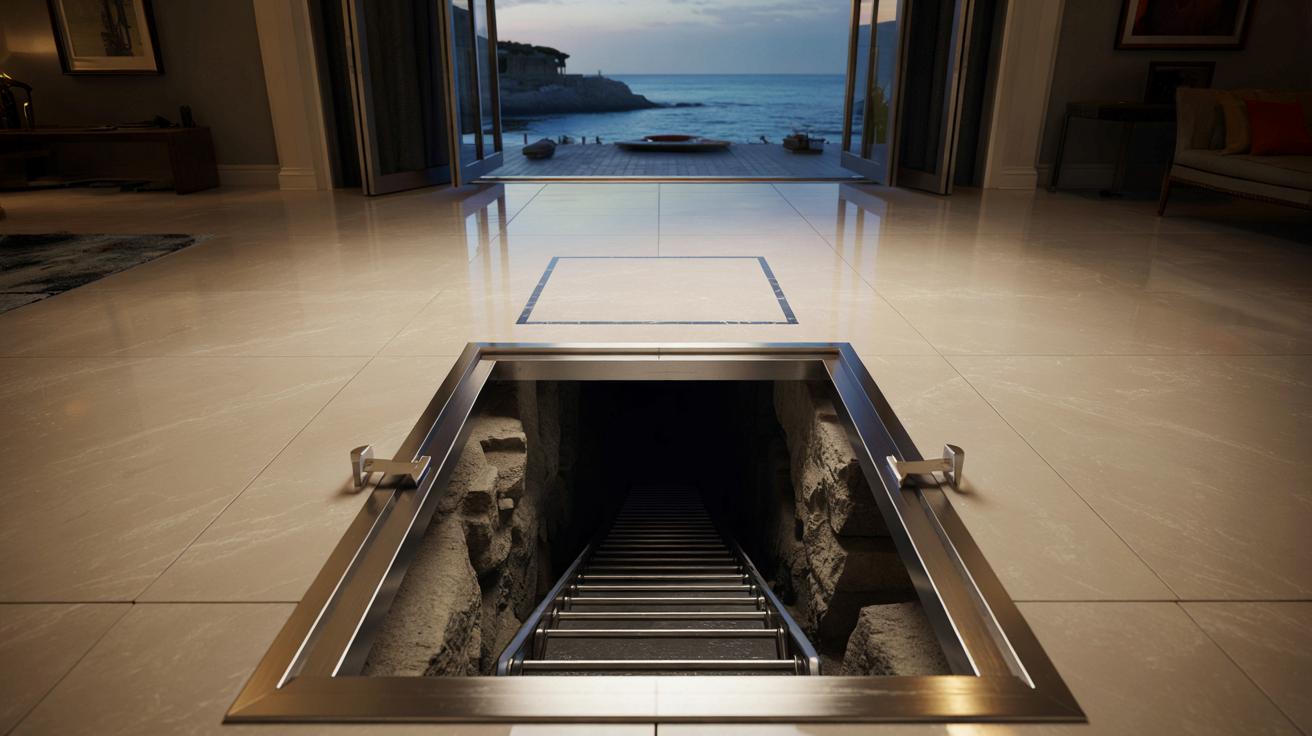
The first time you see the photos, your brain needs a second to process what it’s looking at. A polished marble floor, the expensive kind you only see in billionaire homes. A square outline in the middle, slightly darker, like a healed scar in the stone. Then the next image: the outline is gone. In its place, a dark, yawning hole, framed by stainless steel hinges and a recessed handle. A real trapdoor. In Jeffrey Epstein’s waterfront mansion, leading downwards. And, according to one former employee, “all the way to the sea.”
The ocean glints blue in the background of those same photos, calm and indifferent. You can almost hear the faint slap of waves on the rocks under the terrace. Above, lavish rooms that hosted the world’s richest and most connected men. Below, a hidden passage that vanishes into blackness, punching a hole straight into the house’s foundation. It feels less like architecture and more like a confession in concrete.
A house already drowning in secrets suddenly comes with a literal escape route. A clandestine mouth opening toward the water. And nobody can agree what, or who, it was really for.
Inside the house of secrets: the trapdoor that shouldn’t exist
The mansion itself was already a character in the Epstein story. High walls, cameras tucked under eaves, mirrored interiors that turned every room into a stage set. Former staff described moving through the corridors like they were walking inside a carefully scripted illusion. Every angle controlled, every door monitored. Then someone mentioned a floor panel in the lower level that “wasn’t on any blueprint” they’d seen, a hatch that maintenance staff were told to avoid, no questions asked.
One worker recalled being called late at night to the basement to check a water leak. He noticed the square outline in the floor near a service corridor. Before he could ask, a security man stepped in front of him and said, flatly, “You don’t need to know what’s under that.” Years later, when photos started circulating among investigators, he recognised the spot instantly. The same corridor, the same stone, now open like a wound. The hatch led to a narrow shaft with steel rungs, dripping with condensation.
At the bottom, according to a law enforcement source who spoke off the record, there was a side tunnel cut through the rock. Just wide enough for a man to pass. It ended at a heavy door that opened onto a small platform above the waterline, where a boat could edge in at night without drawing attention from the street. The detail sounds pulled from a Netflix script. Yet the more you talk to people around the case, the more this strange corridor appears as something banal to them: one more tool, in a house designed to bend reality around its owner.
Why would a billionaire need a door to the sea?
Architects who’ve seen partial plans of Epstein’s properties describe a repeating pattern. Hidden rooms. Service tunnels. Blind corners that allowed security staff to move without being seen. On paper, much of this could be sold as “safety” and “logistics.” Discreet entrances for caterers, private exits for VIPs, emergency routes in case of storms. In that light, a trapdoor to the water might sound less like a villain’s lair and more like an over-engineered panic exit on a waterfront lot.
Except most panic exits don’t start with a concealed hatch under polished flooring. Nor do they end in a position where a small boat can slide in under cover of darkness. Neighbours on the shoreline told reporters they would occasionally see a dinghy or tender approach the rocks at odd hours, lights off, engines low. Nothing dramatic. Just shapes moving where, officially, nobody had legal access. When you link that to a secret opening in the foundation, the “safety” argument starts to fray.
Security experts point out a more uncomfortable logic. A hidden sea exit offers three core advantages to someone like Epstein: deniability, flexibility and time. If a guest arrived or left by water, there was no driveway camera, no doorman, no record of a license plate. If police ever came through the front door, anyone in the basement had a chance – even a slim one – to vanish into the night by boat. *Put brutally: you don’t build that kind of passage unless you expect to need to move people unseen.* The physical architecture mirrors the moral one: layers of plausible surface, with rot and improvisation hidden just below.
Reading a crime scene through its walls, not just its files
For investigators, strange pieces of built environment like this trapdoor act like witnesses that can’t be intimidated. They don’t lie, they don’t forget, they don’t change their story ten years later. So one of the first practical steps is almost architectural: map the actual space, not the glossy photos. That means 3D scans of basements, drone images of foundations touching the waterline, sonar from the sea side looking back at the cliffs. The goal is to answer a simple question: is this an improvised hack, or part of a deliberate, professional system?
➡️ Dit eten voor het slapen zorgt voor een perfecte nachtrust
➡️ De nanny van de Prins en Prinses van Wales ontvangt een zeldzame koninklijke onderscheiding
Criminal profilers then look at how the hidden door fits with behaviour that’s already documented. Was there a pattern of guests arriving at strange hours? Unexplained gaps in logs of who came and went? Boats registered to shell companies that matched nights when staff were told to “clear out early”? The sea exit stops being a weird curiosity and becomes one more data point in a messy, human story. This is where the “Netflix” vibe disappears and the unglamorous grind of investigation takes over: door hinges tested for age, screws matched to hardware store purchase records, tidal markings studied to see when a boat could realistically dock without getting smashed against the rocks.
We’ve all been there, that moment when a small, physical detail suddenly changes how you see an entire situation. For detectives, that’s the power of this kind of discovery. One former federal agent, speaking about similar cases, described the “hidden door effect”: once you find one secret route, you start looking for a whole hidden layer of logistics behind a criminal operation. Who built it. Who authorised it. Who knew. Let’s be honest: nobody really does this every single day in normal architecture. When you see it, you’re already in abnormal territory.
The thin line between safety feature and escape route
If you strip away the scandal for a second, the raw idea of a hidden sea access has a neutral side. Coastal homes in storm zones sometimes include reinforced escape paths in case rising water cuts off the street. Yacht owners like private, protected landings for security. The method is almost always the same: start from the practical need, then harden the access point. That means proper stairs, visible emergency lighting, doors that open outward toward rescue. And clear mention somewhere in the house’s safety documentation, because firefighters and coastguards need to know where they’re going.
Where things go dark is when those same techniques get repurposed for secrecy instead of safety. Concealing the entrance under decorative flooring. Leaving the route off official plans. Telling staff they’re “not allowed” near certain areas without giving any lawful reason. That’s when a security feature crosses an invisible threshold. The technology hasn’t changed – just the intent. The worst part is that, from the outside, you can’t always tell which side of that line you’re looking at until something goes wrong and suddenly everybody wants to know how people were getting in and out unseen.
One maritime security consultant summed it up bluntly during a conference: “A hidden door to the sea is either for saving lives, or for hiding them. The concrete doesn’t care which.”
- Look for transparency
If a property has unusual exits that are openly documented, inspected, and coordinated with local services, they’re far more likely to be legitimate safety features. - Watch for patterns of secrecy
Areas that are physically hard to access and socially forbidden to discuss often play a special role in how power is exercised inside a building. - Follow the logistics, not the legend
Forget the thriller-movie aura. Ask: who paid for this, who maintained it, and who had keys or codes? Real answers often sit in invoices and staff routines. - Separate emotion from evidence
Anger at a case like Epstein’s is understandable, yet the truth tends to emerge from slow, boring cross-checking, not the most dramatic theory. - Remember the human scale
Behind any secret passage are workers who poured the concrete, delivered the steel, cleaned the floor above it. Their quiet testimonies can redraw the whole map.
What this trapdoor really says about the world that built it
The image of that hatch in Epstein’s house lingers because it feels like a physical metaphor for something many people already suspected. A world where money buys not only comfort, but alternative routes. Side doors to justice. Quiet exits when things get too hot at the front. The sea tunnel isn’t just about what one man did or didn’t do with it. It points toward an architecture of power that literally shape‑shifts to protect those inside, while everyone else is stuck using the main entrance and waiting in line.
At the same time, the trapdoor is strangely ordinary up close. Hinges bought from a supplier. Stone cut by contractors who probably did five other basements that week. A ladder installed by someone who went home with dust in their hair and dinner to cook. That collision – between everyday labour and obscene privilege – is part of why this detail has haunted public imagination. It shows how exploitation rarely looks like a cartoon villain’s lair, and much more like slightly unusual building choices signed off by people who didn’t ask enough questions.
Maybe that’s the real discomfort here. If a secret door to the sea can be carved into the foundation of a luxury home, almost unnoticed, what else is quietly built into the places we walk past every day? The neglected side stairs nobody uses. The private lift that skips the public floors. The tinted vehicles that slip under a building while the main lobby shines for photos. Stories like Epstein’s force us to look again at the spaces around power and ask where the real exits are. And who they’re truly designed for.
| Key point | Detail | Value for the reader |
|---|---|---|
| Hidden sea access as a red flag | A trapdoor and tunnel to the water, kept off official plans, point to deliberate secrecy rather than ordinary safety design. | Helps readers recognise when “security features” in powerful spaces might actually be escape routes. |
| Architecture as silent witness | Walls, doors and tunnels preserve timelines and intentions in ways people’s memories and alibis don’t. | Shows how looking at the built environment can clarify what really happened behind closed doors. |
| Power reshapes physical space | From private docks to concealed hatches, extreme wealth often buys hidden paths around normal oversight. | Invites readers to question how privilege is literally built into cities, homes and institutions. |
FAQ:
- Was the trapdoor to the sea in Epstein’s house officially documented?Reports from people familiar with the property suggest the hatch and tunnel did not appear on the standard plans shared with most staff, which is exactly what fuels suspicion about their purpose.
- Could the sea passage have been just an emergency exit?Technically yes, but its concealed entrance, narrow design and discreet boat access fit far better with a private escape route than with a regulated safety feature.
- Did neighbours ever see boats using the hidden access?Several shoreline residents described small craft approaching the rocks at unusual hours with minimal lights, although tying specific sightings directly to the trapdoor remains difficult.
- Do other luxury homes have similar hidden sea exits?Some high-end coastal properties include private docks or service tunnels, yet being fully concealed and off the paperwork is far less common and raises sharper questions.
- Why does this detail still matter after Epstein’s death?The secret passage highlights how physical spaces can be engineered to enable abuse and evasion, which is crucial for understanding networks around him and preventing similar systems elsewhere.