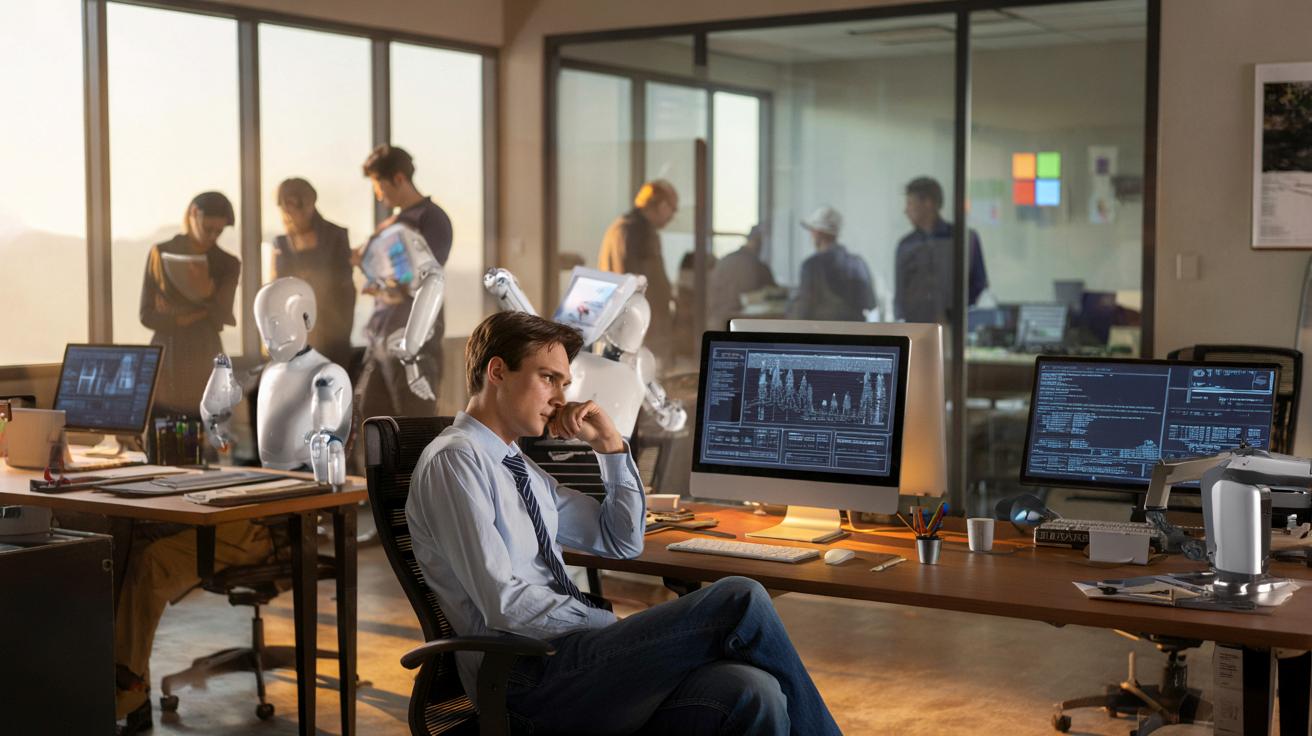
The office lights were still on, but the work was basically done. Screens glowed, Slack was quiet, and half the team was secretly scrolling TikTok while pretending to “wrap up a file”. It was a Tuesday, 4:32 p.m., and no one really knew what they were still doing there.
Your colleague mumbled something about AI “doing everything soon anyway” and joked that they’d happily work three days a week if the robots could take the rest. Everyone laughed.
Then someone dropped the line: “You know Musk and Bill Gates are probably right. We’ll have way more free time… but where are the real jobs going to come from?”
The room went silent for a second.
Because deep down, that question sticks.
When a Nobel Prize winner says the quiet part out loud
Recently, Nobel Prize–winning economist Christopher Pissarides joined this conversation that used to sound like science fiction. He basically sided with Elon Musk and Bill Gates: AI can bring a future with a lot more free time… and a lot fewer traditional jobs.
He didn’t shout doom. He described something almost stranger: societies where humans work less, machines do more, and the old model of “9 to 5 until retirement” quietly collapses.
You can feel it in small ways already. Meetings cut short because an AI made the report. Emails drafted in seconds. Routine tasks that once filled entire days now compressed into a click.
The ground is shifting under our feet.
Pissarides, who shared the Nobel Prize for his work on the job market and unemployment, isn’t some random tech influencer chasing clicks. He’s spent a lifetime studying how jobs appear, how they vanish, and how people get stuck in between.
➡️ Dit eten voor het slapen zorgt voor een perfecte nachtrust
He points to one striking image: AI and robots taking over repetitive, predictable work, from call centers to basic accounting to warehouse logistics. Bill Gates has said that AI could become a “digital worker” that handles a big chunk of office tasks. Musk talks about “universal high income” and robots doing “everything”.
Strip away the exaggerations and you still land on the same picture. A lot of the work that pays rent today is precisely the kind of work AI is learning to do frighteningly well.
From there, the Nobel Prize winner’s logic is chillingly simple. If productivity goes up because machines do more, society can choose: either keep people working the same hours and explode profits, or redistribute that gain in the form of shorter weeks, earlier retirement, or new forms of paid time.
The catch is brutal. Our institutions, social protections, and even our identity are still wired around having a “proper job”. That’s where your status, your salary, your right to housing and credit come from.
So yes, **more free time** is attractive on paper. Yet if classic jobs melt away faster than new ones appear, freedom can look a lot like forced idleness.
And that gap between promise and reality is where anxiety lives.
Preparing yourself for a world with fewer classic jobs
So what do you actually do when a Nobel Prize winner gently tells you that your career map is outdated? You don’t need a full panic rebrand overnight. You need a quiet, stubborn strategy.
One simple method stands out: shift your focus from “my job title” to “my transferable skills”. Your job might be accountant, receptionist, marketing assistant, customer support. Underneath that, you’ve got skills: negotiation, empathy, writing, data analysis, conflict resolution, creativity.
Take thirty honest minutes and list everything you do in a week that a robot still can’t do as well as you. Talking someone down from anger. Reading a room in a meeting. Explaining something complex in simple words.
That list is your anchor in the storm.
A second move: experiment with tiny “side tests” of the future, not giant life decisions. You don’t need to quit your job and launch a startup tomorrow. Try a weekend freelance mission. Launch a micro-newsletter about a niche you love. Explore platforms where people pay for very human skills: tutoring, coaching, local services, crafts, content.
We’ve all been there, that moment when you stare at LinkedIn and everything looks both boring and unsafe at the same time. So shrink the scale. One small test this month. Another next month.
Let’s be honest: nobody really does this every single day. But the people who experiment, even clumsily, are the ones who spot new paths before everyone else.
Pissarides insists on a key point that rarely makes headlines: none of this transformation is automatic. It needs rules, protections, and political choices. Bill Gates talks about taxing robots. Musk throws around the idea of universal basic income.
In the middle of these big words, there’s us. Ordinary people trying to plan rent, kids, and holidays in a world run by algorithms and quarterly earnings.
“Technological progress will not inevitably lead to good jobs for all. It must be steered,” Pissarides has warned in interviews. “We have to think seriously about how to share the gains.”
- Map what AI can already do in your job today
- Identify three skills you use that are deeply human
- Run one small, low-risk test of a new income source
- Talk openly about work and time with friends or colleagues
- Follow debates on basic income, shorter workweeks, and job protection
A future with more time… and more questions
The strangest part of this whole story is not the robots. It’s the time. If Musk, Gates and Pissarides are roughly right, entire chunks of our week will loosen up over the next decade. Four-day weeks, flexible hours, or intermittent contracts could become the norm in many sectors.
On paper, it sounds like a dream. Extra days to sleep, care for loved ones, learn, create, breathe. *A life that doesn’t revolve entirely around the office badge.*
But there’s a darker version of the same film. People with strong networks and rare skills enjoying soft, creative lives. Others drifting between underpaid gigs, unstable contracts, and endless upskilling courses that never quite pay off.
The Nobel Prize perspective reminds us of something a bit uncomfortable: **technology doesn’t decide our future, we do**. Through laws, taxes, education, and small daily choices about what we value and reward.
So maybe the real conversation isn’t “Will AI steal my job?” but “What do we want to do with the time that AI gives back to us, and who gets to enjoy that gift?”
Ask yourself what kind of week you’d want if the classic five-day grind wasn’t mandatory anymore. Less work, yes, but for what? Family, art, volunteering, a quiet life, learning, doing nothing?
This is the moment to talk about it, to push for it at work, in politics, at the dinner table. Because by the time the robots fully arrive, the rules of the game will already be written.
| Key point | Detail | Value for the reader |
|---|---|---|
| AI will shrink many classic jobs | Nobel Prize winner Pissarides backs Musk and Gates on major automation of routine work | Helps you understand why your current job description may not last |
| More free time is plausible | Higher productivity could enable shorter workweeks and flexible schedules | Opens space to imagine and plan a different rhythm of life |
| Preparation starts with human skills | Focusing on uniquely human abilities and small experiments reduces risk | Gives you concrete levers instead of vague anxiety |
FAQ:
- Question 1Are Elon Musk and Bill Gates exaggerating when they say most jobs could disappear?
- Question 2What exactly does the Nobel Prize winner Pissarides agree with?
- Question 3Which kinds of jobs are most exposed to AI and automation?
- Question 4How can I personally prepare for fewer classic full-time roles?
- Question 5Will we really have more free time, or just more pressure to hustle on the side?